Pricing software for mid-size distributors: 9 options compared
Most pricing software is built for a company with a pricing department. A mid-size distributor usually has thousands of SKUs, costs that move every month, and one person who owns pricing on top of another job.
Start with who will do the work. Pricefx, Vendavo, Zilliant and Conga (formerly PROS) give a pricing team analysis and guidance to act on. SPARXiQ and epaCUBE help you build a pricing structure. Hawkeye’s AI agents go through every price and hand your team the changes to approve.
We make Hawkeye, so we’re not neutral. We’ve tried to be fair about where each option fits better than ours. Every fact here has a source at the bottom.
By Adam Honig, CEO of Hawkeye Pricing. Last updated October 29, 2026.
The short answer
No pricing team, or an overworked one:Hawkeye Pricing. The agents do the analysis and your team approves the changes.
On Epicor, and you’ve never segmented customers:SPARXiQ or epaCUBE to build the structure.
A full-time pricing team, SAP or Oracle, and a budget in six figures:Pricefx, Zilliant or Vendavo.
Reps discounting past the rules is the main problem:Vendavo, or the override controls in SPARXiQ.
Roughly $20 million to $500 million in revenue. Thousands to hundreds of thousands of SKUs. Costs that move every month because of suppliers, tariffs and freight. Zero to two people who own pricing, and they have other jobs too. An ERP like Epicor P21 or Eclipse, Infor, NetSuite or SAP.
At that size, nobody has time to work through another dashboard. Whatever you buy has to fit the hours your team actually has.
What we found in one distributor’s invoices
One distributor we work with sold about 6,000 products last year. Three out of four went to exactly one customer, and those products were 75% of its revenue. That’s the long tail: thousands of prices, each set once for one account, that nobody has a reason to look at again.
About one in four of its customer prices hadn’t moved in 12 months. Many of those were fine, since more costs fell than rose. But where cost went up under a flat price, margin on that account dropped a median 4.6 points.
How we measured it: every customer and product pair bought in the 12 months to October 28, 2026, compared with what that customer paid a year earlier. “Hadn’t moved” means within 0.5%. Fees, freight and internal sales are left out. The margin figure covers about 175 prices where cost rose more than 2%.
The options
1Hawkeye Pricing
Best for: Distributors with thousands of SKUs and an overworked pricing team, or none at all.
AI agents read your ERP every night, check every SKU for every customer, and hand your team a short list of price changes with the reason for each one: a cost that rose under a price that didn’t, a customer still paying a price set eight months ago, five customers paying five prices for the same item. You approve the ones you agree with and they’re in your ERP the next day. Our first customer, a packaging equipment maker, had its agents check about 3,000 parts. At the first review, the team approved 60 of 62 changes, and on 25 of them picked a lower price than the agent suggested. The typical approved change is about 5%, and the same price can’t move again for 30 days.
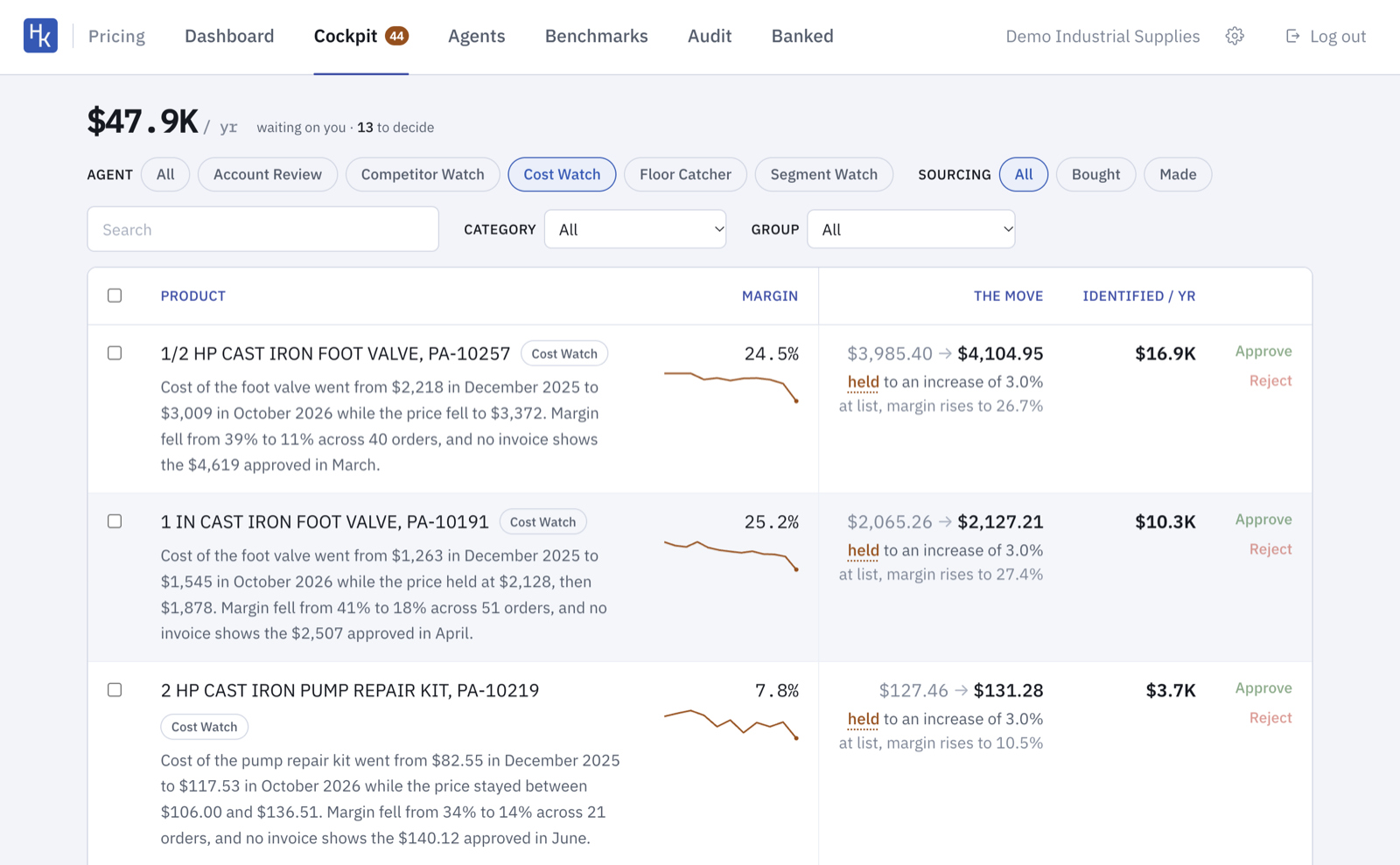
The Cockpit, where your team approves or rejects each change. From our demo, not a customer.
Watch out for: It doesn’t do quoting, CPQ, rebates or deal approvals. If your problem is reps discounting past the rules, a governance tool fits better. It needs people, too: when a cost in your ERP looks wrong, the agents flag it, but someone on your team has to fix it. We’re also the newest company on this list, and we aren’t SOC 2 compliant yet. See when Hawkeye is the wrong choice.
Price
A one-time setup fee, then a share of the margin each approved change adds, for 12 months. If it adds no margin, the setup fee is all you pay.
Getting started
We run it on a year of your invoices before you buy. A file export is enough.
Best for: Epicor distributors in electrical, HVAC, plumbing and industrial that need to build a pricing structure.
A Cleveland pricing and sales training firm founded in 1993. It sets target prices and margin ranges for groups of customers and products, and it’s the engine behind Epicor’s Strategic Pricing module for P21, Eclipse and Kinetic. It also sells override controls, contract and rebate tools, and sales training.
Watch out for: It prices groups, not items, and the recommendations are only as current as the last batch of data you sent. Your team loads them into the ERP.
Best for: HVAC, electrical and plumbing distributors that want pricing analysts working alongside them.
A Fort Worth company of about 20 people, owned since 2024 by Cordance, which is backed by private equity firm Aquiline. It grades customers A to D, sets targets by product segment, and feeds a price matrix. Its analysts meet with your team, often weekly, to work through it. It’s an NAED Preferred Provider and a HARDI partner.
Watch out for: It runs on meetings. Its own case studies describe weekly sessions for months. It prices segments, not items, and your item data needs cleaning first.
Price
Not published.
Getting started
Months of recurring sessions, by its own case studies.
Best for: Larger distributors and manufacturers with a pricing team, especially on SAP and Salesforce.
An Austin company owned by Madison Dearborn Partners. Price optimization, price lists, customer agreements and CPQ. Customers include Ben E. Keith, Dawn Foods and Farnell. In November 2025 it launched Pricing Plus for companies moving off spreadsheets.
Watch out for: Built for a pricing team to analyze and act on. Reviewers describe long implementations. Pricing Plus connected through CSV files at launch.
Price
Not published. About $60,000 to $150,000+ a year, plus $75,000 to $250,000 to implement, per Data Tool Index.
Getting started
Several months for most projects. Pricing Plus targets first prices around day 30.
Best for: Large manufacturers and distributors on SAP with a pricing team that wants a configurable platform.
Founded in Germany in 2011, US headquarters in Chicago, venture-backed. Price management, AI optimization, quoting, agreements and rebates in one platform. Its 125 prebuilt agents, launched in 2025, rank margin problems for your team. Pricefx says they don’t change prices themselves.
Watch out for: Data Tool Index says implementation takes 6 to 12 months, mostly through consulting partners, and that it rarely pays off below $50 million in revenue. Pricefx says under six months. SAP is the only ERP on its integration page.
Price
Not published. About $50,000 to $150,000 a year, plus $100,000 to $200,000 to implement, per Data Tool Index.
Getting started
6 to 12 months per Data Tool Index, usually with a partner. Pricefx says under six.
Best for: Distributors whose problem is discount approvals and deal governance. Data Tool Index says it fits industrial distributors with $20 million to $250 million in revenue.
A Denver company owned by Francisco Partners and Accel-KKR, with more than 200 customers including Volvo, 3M and Ferguson. Price rules, quoting and agreements, rebates and margin analytics. AI agents for price management, optimization and deal desk launched in 2025.
Watch out for: Built for a pricing team and a deal desk. Reviewers’ top complaints are complexity and customization. Epicor, Infor and NetSuite aren’t on its integration list.
Price
Not published. About $75,000 a year for one module, $150,000 to $200,000+ for the suite, plus implementation, per Data Tool Index.
Best for: Large companies that want AI price optimization and quoting from one vendor.
PROS sold its B2B pricing business to Conga, a quoting and contracts software company, in February 2026. Conga is combining PROS price optimization with its own CPQ and contract management. Like PROS before it, Conga is owned by Thoma Bravo.
Watch out for: PROS was built for big enterprises with a pricing operations team, and implementations ran long. Product names have changed. Conga promises continued support but hasn’t published a roadmap. Ask what changes at your renewal.
Price
Not published. Data Tool Index puts it at $100,000 to $300,000 a year, plus $200,000 to $800,000 to implement, still listed under PROS in April 2026.
Best for: Distributors with a few thousand SKUs, stable costs, and someone who owns pricing.
Epicor P21 and Eclipse, Infor, NetSuite and SAP all ship with price matrices, customer price pages and contract pricing. Most mid-size distributors already run on these, plus a spreadsheet for cost increases.
Watch out for: Nothing in the ERP tells you which prices are stale. Across-the-board increases hit the items that didn’t need it and miss the ones that did.
Price
Already paid for.
Getting started
Today.
9Hire a pricing analyst
Best for: Companies that want pricing judgment in-house and have someone to manage it.
A good pricing analyst knows your customers, argues with sales, and builds the rules everything else depends on. Most of the tools above assume you already have one.
Watch out for: One person can’t check every price for every customer every night. A lot of their week goes to pulling data and building spreadsheets, and the long tail waits for next year’s review.
Price
About $90,000 a year in salary, before benefits.
Getting started
As long as it takes to hire, then a few months to learn your data.
When Hawkeye is the wrong choice
We’ve told people on sales calls that Hawkeye wasn’t for them. It came down to one of these:
You’re a manufacturers’ rep. The manufacturer sets the price and you sell on commission. There’s no price for you to change.
You quote every order. Project and quote-to-order work has no catalog price sitting in the ERP for the agents to check.
Your costs barely move. If costs rise 2% to 5% a year and one catalog update a year keeps up, a yearly review already does the job.
How to choose
1. Who will do the work?
Every platform here except Hawkeye needs someone to turn its output into price changes in the ERP. Count the hours a week your team can give it before you look at features.
2. Is the problem bad prices or bad discounting?
If list and customer prices are right and reps give the margin away on quotes, you need governance: approval rules, override limits, a deal desk. If costs rose and thousands of prices never followed, you need someone, or something, going through every price.
3. Does it work with your ERP?
Pricefx, Vendavo, Zilliant and Conga all list SAP. None of them lists Epicor or Infor. If you run Epicor, Infor or NetSuite, ask exactly how data gets in, how often, and how approved prices get back out.
4. How fast will you know if it works?
With a 6 to 12 month implementation, you pay for months before the first price changes. Ask every vendor to show you results on your own data before you sign.
Questions about pricing software for distributors
The last eight are questions distributors asked us on sales calls.
What is the best pricing software for a mid-size distributor?
It depends on who will do the work. With no pricing team, or an overworked one, Hawkeye Pricing’s agents find the price changes and your team approves them. On Epicor and starting from scratch, SPARXiQ or epaCUBE help build a pricing structure. With a full-time pricing team, SAP and a six-figure budget, look at Pricefx, Zilliant and Vendavo.
How much does distributor pricing software cost?
Most vendors don’t publish prices. Data Tool Index, a software review site, puts Pricefx at $50,000 to $150,000 a year, Zilliant at $60,000 to $150,000 or more, and Vendavo at $75,000 to $200,000 or more, each plus a separate implementation that can cost as much again. Hawkeye charges a one-time setup fee, then a share of the margin each approved change adds, for 12 months.
Do I need a pricing team to use pricing software?
For most platforms, yes. Pricefx, Vendavo, Zilliant and Conga produce analysis, models and alerts that a pricing person turns into price changes. SPARXiQ and epaCUBE need someone to load recommendations or sit in regular sessions. Hawkeye was built for companies without a pricing team: its agents propose specific changes and write the approved ones to the ERP.
What happened to PROS pricing software?
PROS was taken private by Thoma Bravo in 2025. In February 2026, Conga, another Thoma Bravo company that makes quoting and contract software, bought the PROS B2B pricing business. PROS kept its airline business. PROS B2B customers are now Conga customers.
Which pricing software works with Epicor P21 and Eclipse?
SPARXiQ is the engine behind Epicor’s own Strategic Pricing module for P21, Eclipse and Kinetic. epaCUBE’s case studies name P21 and Eclipse. Hawkeye works with Epicor Eclipse, P21 and Kinetic. Pricefx, Vendavo and Zilliant don’t list an Epicor connector.
Can my ERP’s built-in pricing do the job?
For a few thousand SKUs with stable costs and someone who owns pricing, often yes. ERP price matrices and customer price pages hold prices well. They don’t tell you which ones went stale when costs moved, which is where margin leaks between price reviews.
Won’t my sales reps just override the new prices?
Reps override prices they don’t understand, and big jumps get the most attention. Hawkeye makes small changes and explains each one. At our first customer, the typical approved change is about 5%, and the same price can’t move again for 30 days. We brought their reps into the process early, and we haven’t seen pushback. Small, steady changes are easier for reps and customers to accept than one big increase a year.
How do I know why a price is recommended?
Every recommendation comes with its reason and the numbers behind it: a cost that rose under a price that didn’t, a margin well under similar items, a customer paying a price set eight months ago. “It can’t just be a number,” one distributor told us. Otherwise reps are “just going to decide the computer doesn’t know anything.”
Will my customers push back?
Customers on a contract or a price hold are skipped until renewal. Then Hawkeye proposes a new price list for that customer, so the change goes out once, when the contract allows it. For everyone else, changes are small and spread out. Our first customer hasn’t heard a complaint yet.
What if the data in my ERP is wrong?
Some of it usually is. When a cost or price looks impossible, the agents flag it. Someone on your team still has to fix the record. Plan on your people and the agents working on it together.
Does Hawkeye change prices on its own?
Only if you let it. Each agent has three settings: Off, Approval and Auto. On Approval, nothing reaches your ERP until someone approves it.
What happens when we upgrade our ERP?
Hawkeye reads your ERP every night through its API, or from files your ERP sends us. If the upgrade doesn’t change the API or the file layout, nothing needs to happen on either side.
Is our data used to train AI models?
No. Customer data never trains a model. Hawkeye isn’t SOC 2 compliant yet, so tell us early if your IT team requires it.
Is the margin share forever?
No. Hawkeye’s share of the margin from each approved change runs for 12 months. After that, the margin from that change is all yours.